Duration:
January 6 - March 16
(10 weeks)
A UX Case Study
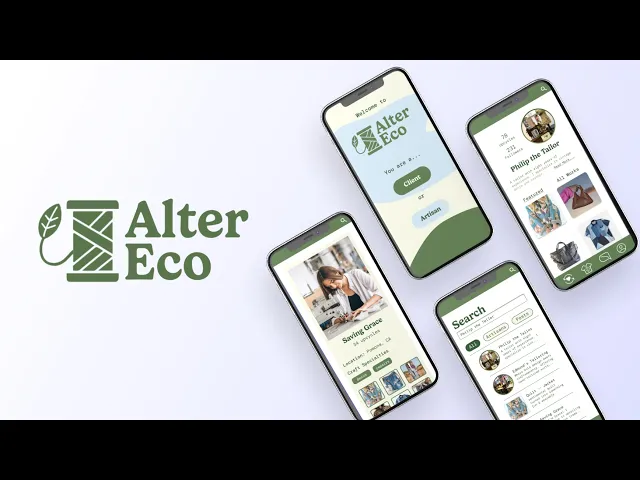
AlterEco - Every Piece has a Past, Let’s Give it a Future
A matchmaking platform between customers and artisans that promotes clothing sustainability

How did I...
Not just design, but also take into account the business and marketing aspects of creating a startup
My Role
Logo design, competitive analysis, prototyping
Video Promotion
Our Solution
A unique matchmaking platform where clothes you don’t wear anymore can gain a new life through the work of creative and talented artisans

The Problem & Our Concept
92 million tonnes of textile waste is produced every year.
Globally, just 12% of the material used for clothing ends up being recycled
“The dominant business model in the [fashion] sector is that of ‘fast fashion’,
Not only is the average person buying 60 per cent more items of clothing than they did 15 years ago but, according to the McKinsey 2019 State of Fashion report, they are only keeping them as half as long as they used to.” (UN News 2019)

Competitive Analysis
To get some inspiration in how to format our initial idea, we took a look at some competitors related to clothing and compared them.
Enable individuals to buy, sell, and discover unique or secondhand fashion items
Divert clothing from landfills by collecting and recycling or repurposing them.
Promote sustainable fashion by extending garment life. Connect users with local seamstress/tailors for repairs and alterations


User Research
We sent our survey to fashion/sustainability subreddits, community discord servers, and people we knew with questions related to what kind of clothing they preferred to buy and if they took any initiatives in sustainability such as sewing, etc.
Storyboards
Despite surface-level demographic similarities (i.e. age), our interviewees represent extraordinarily diverse opinions and skill sets that were able to comment on our storyboards from different angles.
were conscientious of sustainability and ethics when making clothing consumption decisions
knew how to repair their clothes and another 2 interviewees were willing to learn
were skeptical about ideas involving effort from the consumer (e.g. learning to upcycle themselves)
4/5
2/5
3/5

With both pages having 50/50 weight, we found that version A did better in terms of statistics.

Broad Color Palette (greens, blue, white, off-white, orange)
Minimalistic
Modern


Variant A
Variant B
Refined Color Palette (green, blue, white)
Cartoonish
Fun
Web Probes
We had two slightly different ideas for the final product so far, and in order to solidify which we would pick we tried an A/B testing for a possible product page in terms of marketing.
total impressions
clicks
4.73k
215
Marketing Campaign
For the ads we ran through our GoogleAds campaign, we used these keywords to reach audiences we felt would be interested in our service:

GoogleAds required several short headlines, long headlines, and descriptions that it would mix and match to determine optimal pairings, so there was no way to do a clean-cut A/B test. These are the assets we ended up using within their campaign structure.

Although GoogleAds did not provide us with quantitative performance metrics for each asset, it did offer a relative rating system for which assets performed best.
From these results we can see that assets focusing more on style or general consumer interests performed slightly better, but that concerns about fast fashion and sustainability were also impactful in generating clicks.
Mid Fidelity Iterations
After solidifying our finalized idea, we began working on the app interface based on what we learned from our marketing campaign and interviews for our minimal viable product (MVP).

Onboarding page
Artisan search
Clothes alteration form
Messaging
Artisan profile


After conducting user testing we learned:
the preferences section (lab) needs to be changed up, make the options a lot more clear, so that the artisan has a better understanding of what they are working with
to foster community outside of the app → link to artisans social media pages
have an option to switch between artisan and consumer page
during the process it is important to include mockups or something along those lines to ensure that the consumer knows exactly what that is going to be
High-Fidelity Prototype


Client Perspective
Artisan Perspective
Key Takeaways
What I learned from this project is not just creating a business, but innovating in the lens of a startup. This was especially different from so many other UX projects I’ve done in that it’s not just the visuals and functions of the product that matters, but also the business aspect. In this age of online advertisement, learning how to market your product either through traditional online methods or with platforms like LinkedIn is essential. I’ll use the skills I learned here in order to have a fuller perspective of what goes into creating a new product.
